" width="95px"><path d="M 0 0 L 95 0 L 95 19 L 0 19 Z" fill="transparent" height="19px" id="f141K9XUg" width="95px"/><path d="M 1.906 0 C 2.959 0 3.813 0.863 3.813 1.927 C 3.813 2.992 2.959 3.854 1.906 3.854 C 0.853 3.854 0 2.992 0 1.927 C 0 0.863 0.853 0 1.906 0 Z M 0.254 5.818 L 3.468 5.818 L 3.468 15.233 L 0.254 15.233 Z M 5.737 15.233 L 8.951 15.233 L 8.951 9.727 C 8.951 8.975 9.368 8.149 10.44 8.149 C 11.583 8.149 12.074 8.975 12.074 9.911 L 12.074 15.233 L 15.287 15.233 L 15.287 9.617 C 15.323 8.901 15.759 8.149 16.776 8.149 C 17.92 8.149 18.41 8.975 18.41 9.911 L 18.41 15.233 L 21.624 15.233 L 21.624 9.03 C 21.624 6.405 19.699 5.543 17.992 5.543 C 16.976 5.543 15.886 6.075 14.906 7.268 C 14.252 6.002 12.891 5.543 11.656 5.543 C 10.639 5.543 9.713 6.075 8.987 6.809 L 8.951 6.809 L 8.951 5.818 L 5.737 5.818 Z M 23.621 15.233 L 26.834 15.233 L 26.834 9.727 C 26.834 8.975 27.252 8.149 28.323 8.149 C 29.467 8.149 29.957 8.975 29.957 9.911 L 29.957 15.233 L 33.171 15.233 L 33.171 9.617 C 33.207 8.901 33.643 8.149 34.659 8.149 C 35.803 8.149 36.293 8.975 36.293 9.911 L 36.293 15.233 L 39.507 15.233 L 39.507 9.03 C 39.507 6.405 37.582 5.543 35.876 5.543 C 34.859 5.543 33.77 6.075 32.789 7.268 C 32.136 6.002 30.774 5.543 29.539 5.543 C 28.523 5.543 27.597 6.075 26.871 6.809 L 26.834 6.809 L 26.834 5.818 L 23.621 5.818 Z M 50.927 10.975 C 50.945 10.865 50.945 10.663 50.945 10.535 C 50.945 7.231 48.785 5.543 45.952 5.543 C 43.138 5.543 40.832 7.782 40.832 10.535 C 40.832 13.269 43.138 15.509 45.952 15.509 C 48.022 15.509 49.729 14.829 50.782 13.049 L 48.458 11.875 C 47.677 12.719 47.223 12.921 46.188 12.921 C 45.371 12.921 44.173 12.425 44.173 10.975 Z M 44.264 9.177 C 44.318 8.314 44.936 7.653 46.043 7.653 C 46.987 7.653 47.659 8.186 47.804 9.177 Z M 52.416 15.233 L 55.629 15.233 L 55.629 10.278 C 55.629 10.039 55.865 8.369 57.536 8.369 C 58.607 8.369 59.206 8.883 59.206 8.883 L 60.55 6.13 C 60.55 6.13 59.714 5.543 58.516 5.543 C 56.682 5.543 55.666 7.176 55.666 7.176 L 55.629 7.176 L 55.629 5.818 L 52.416 5.818 Z M 65.361 5.543 C 62.91 5.543 61.294 6.644 61.294 8.571 C 61.294 9.984 62.238 10.645 63.182 11.14 C 64.235 11.691 65.252 11.746 65.252 12.425 C 65.252 13.049 64.707 13.104 64.253 13.104 C 63.219 13.104 61.948 12.021 61.948 12.021 L 60.64 14.242 C 60.64 14.242 61.984 15.509 64.235 15.509 C 66.142 15.509 68.647 15.068 68.647 12.297 C 68.647 10.37 67.049 9.672 65.815 9.287 C 65.016 9.03 64.362 8.883 64.362 8.387 C 64.362 7.947 64.653 7.818 65.361 7.818 C 66.341 7.818 67.431 8.406 67.431 8.406 L 68.484 6.277 C 68.484 6.277 67.158 5.543 65.361 5.543 Z M 71.897 0 C 72.95 0 73.803 0.863 73.803 1.927 C 73.803 2.992 72.95 3.854 71.897 3.854 C 70.844 3.854 69.991 2.992 69.991 1.927 C 69.991 0.863 70.844 0 71.897 0 Z M 70.245 5.818 L 75.404 5.811 C 75.404 5.811 71.946 6.741 71.921 10.426 C 71.895 14.377 75.847 15.199 75.847 15.199 L 70.245 15.233 Z M 79.103 15.205 L 84.633 15.208 L 84.633 9.886 C 84.633 8.95 85.577 8.05 86.54 8.05 C 87.575 8.05 88.21 8.95 88.21 9.886 L 88.21 15.208 L 91.424 15.208 L 91.424 9.005 C 91.424 6.38 89.045 5.517 87.338 5.517 C 86.322 5.517 85.396 6.05 84.67 6.784 L 84.633 6.784 L 84.633 5.793 L 79.449 5.814 C 79.449 5.814 83.03 6.545 83.134 10.416 C 83.233 14.115 79.103 15.205 79.103 15.205 Z" fill="rgb(243, 241, 249)" height="15.508518576655096px" id="BrOY0jDQO" transform="translate(1.611 1.675)" width="91.42354276158623px"/><path d="M 1.906 0 C 2.959 0 3.813 0.863 3.813 1.927 C 3.813 2.992 2.959 3.854 1.906 3.854 C 0.853 3.854 0 2.992 0 1.927 C 0 0.863 0.853 0 1.906 0 Z" fill="rgb(70, 112, 205)" height="3.854188048636182px" id="yIBDdP8YK" transform="translate(77.207 10.186)" width="3.8127090301003363px"/></g></svg>)
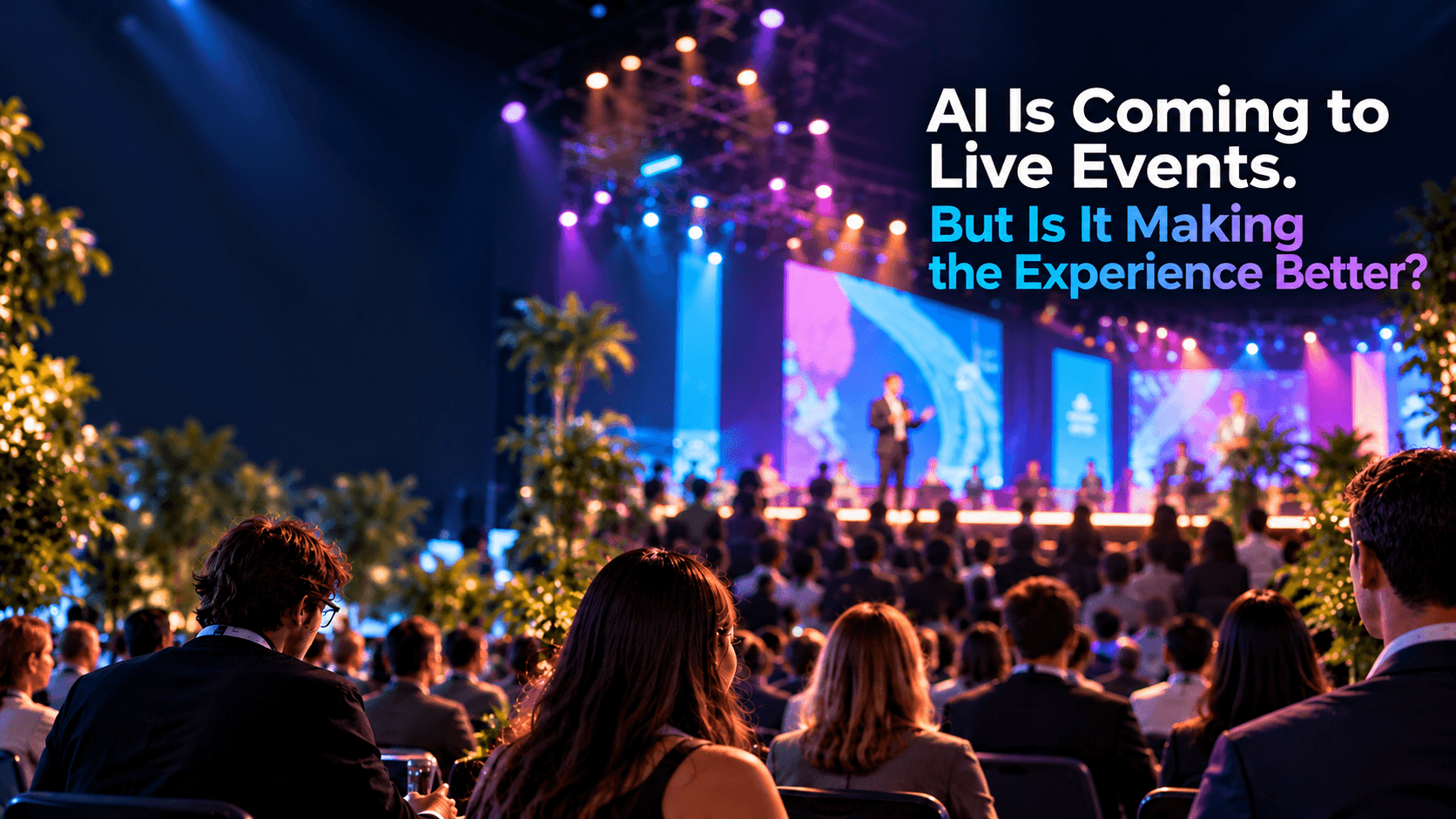
AI Is Coming to Live Events. But Is It Making the Experience Better?
AI is transforming live events, from personalized agendas and matchmaking to attendee support. But how can organizers tell whether these tools actually improve the attendee experience? Paul Zak explores why traditional event metrics fall short and how real-time neuroscience measurement can help event designers understand and maximize Return on Experience (ROX).

Paul Zak, PhD
Founder
Share
AI is rapidly moving from the back office to the event itself.
Until recently, event organizers primarily used AI for marketing—writing emails, creating social posts, and generating content. That is changing. The 2026 State of AI and XR in Events report from Events.com finds that organizers increasingly want AI to handle event logistics, attendee support, check-in, matchmaking, and data analysis. Interest in using AI for executing tasks has jumped 52%.
AI isn't just helping produce the event anymore. It is becoming part of the attendee experience.
And that creates a new challenge: How do we know if AI actually makes the experience better?
Efficient Doesn't Necessarily Mean Better
An AI concierge can answer questions faster. An algorithm can recommend sessions. AI can match attendees, personalize agendas, reduce check-in lines, or recommend exhibitors.
Those are measurable operational improvements.
But did they make the experience more valuable to the attendee?
The Events.com report captures this concern. Organizers are enthusiastic about AI but remain careful about ensuring attendees have a great experience. When asked about barriers to implementing AI, 21% said it can feel impersonal; others cited attendee adoption, implementation difficulties, and unclear ROI.
This is the paradox of using AI at live events. We can easily measure whether AI makes an event more efficient. But efficiency isn't why people attend live events.
They come for experiences.
AI Needs an Experience Metric
Consider an AI-personalized conference.
One attendee receives a recommendation to attend a particular breakout session. Another is introduced to someone through AI matchmaking. A third is directed to a product demonstration based on their interests.
Traditional event analytics can tell us whether they followed those recommendations.
But they don't tell us whether the recommendations created value.
Did the session engage them? Was the introduction valuable? Did the product demonstration produce a meaningful response? Did AI improve their experience—or simply move them around differently?
Post-event surveys are a blunt instrument for answering these questions. They compress hours or days of experiences into a handful of typically inaccurate retrospective ratings.
Live experiences happen moment by moment. They should be measured the same way.
Measure ROX Second by Second
ImmersionLive measures the neurologic value of an experience every second.
A subset of attendees are invited to wear a lightweight arm-worn sensors while participating in the event. Event staff simply wave the wearable over an iPad and viola' neurologic data are being collected. ImmersionLive passively measures their neurophysiologic responses to identify which moments produce value and which do not. All data are private and anonymous, and include basic demographics. Bluetooth beacons connect to ImmersionLive software to identify where attendees are located when peak Immersion experiences occur.
This gives event designers an objective, continuous measure of the Return on Experience—ROX.
Now AI interventions can actually be tested.
Did AI matchmaking produce more valuable conversations? Did personalized session recommendations increase attendee value? Did an AI concierge improve the experience? Which speakers, sessions, activations, and networking opportunities produced the highest ROX—and for whom?
Turn AI Into a Learning System
This is where combining AI and ImmersionLive becomes powerful.
AI personalizes the experience. ImmersionLive measures whether that personalization increased value to the attendee.
Instead of assuming that an AI recommendation created value because someone clicked it or gave it four stars afterward, event designers can measure the attendee's response objectively while the experience is actually happening.
The result is a continuous feedback loop for improving the attendee experience.
The State of AI and XR in Events report identifies operations and execution as AI's next major opportunity in events.
There is another opportunity immediately behind it:
Measure whether AI actually improved the attendee experience.
That's how event designers move from simply using AI to using AI to maximize ROX.
Use the link here to get a demo of ImmersionLive today.
FAQs
How is AI being used at live events?
Event organizers are using AI to personalize agendas, recommend sessions, facilitate networking, provide attendee support, and streamline event logistics. While these applications can improve efficiency, they don't necessarily demonstrate whether attendees find the experience more valuable.
How can event organizers measure attendee experience in real time?
Passive neurophysiological measurement can help event organizers identify which moments create value as an experience unfolds. ImmersionLive uses wearable sensors to measure attendee responses continuously, providing insights that complement traditional event analytics and post-event surveys.
What is Return on Experience (ROX)?
Return on Experience (ROX) measures the value an experience creates for participants. Unlike traditional event ROI metrics, which often focus on financial outcomes or attendance, ROX helps organizers understand which sessions, interactions, and activations deliver meaningful value to attendees.


