" width="95px"><path d="M 0 0 L 95 0 L 95 19 L 0 19 Z" fill="transparent" height="19px" id="f141K9XUg" width="95px"/><path d="M 1.906 0 C 2.959 0 3.813 0.863 3.813 1.927 C 3.813 2.992 2.959 3.854 1.906 3.854 C 0.853 3.854 0 2.992 0 1.927 C 0 0.863 0.853 0 1.906 0 Z M 0.254 5.818 L 3.468 5.818 L 3.468 15.233 L 0.254 15.233 Z M 5.737 15.233 L 8.951 15.233 L 8.951 9.727 C 8.951 8.975 9.368 8.149 10.44 8.149 C 11.583 8.149 12.074 8.975 12.074 9.911 L 12.074 15.233 L 15.287 15.233 L 15.287 9.617 C 15.323 8.901 15.759 8.149 16.776 8.149 C 17.92 8.149 18.41 8.975 18.41 9.911 L 18.41 15.233 L 21.624 15.233 L 21.624 9.03 C 21.624 6.405 19.699 5.543 17.992 5.543 C 16.976 5.543 15.886 6.075 14.906 7.268 C 14.252 6.002 12.891 5.543 11.656 5.543 C 10.639 5.543 9.713 6.075 8.987 6.809 L 8.951 6.809 L 8.951 5.818 L 5.737 5.818 Z M 23.621 15.233 L 26.834 15.233 L 26.834 9.727 C 26.834 8.975 27.252 8.149 28.323 8.149 C 29.467 8.149 29.957 8.975 29.957 9.911 L 29.957 15.233 L 33.171 15.233 L 33.171 9.617 C 33.207 8.901 33.643 8.149 34.659 8.149 C 35.803 8.149 36.293 8.975 36.293 9.911 L 36.293 15.233 L 39.507 15.233 L 39.507 9.03 C 39.507 6.405 37.582 5.543 35.876 5.543 C 34.859 5.543 33.77 6.075 32.789 7.268 C 32.136 6.002 30.774 5.543 29.539 5.543 C 28.523 5.543 27.597 6.075 26.871 6.809 L 26.834 6.809 L 26.834 5.818 L 23.621 5.818 Z M 50.927 10.975 C 50.945 10.865 50.945 10.663 50.945 10.535 C 50.945 7.231 48.785 5.543 45.952 5.543 C 43.138 5.543 40.832 7.782 40.832 10.535 C 40.832 13.269 43.138 15.509 45.952 15.509 C 48.022 15.509 49.729 14.829 50.782 13.049 L 48.458 11.875 C 47.677 12.719 47.223 12.921 46.188 12.921 C 45.371 12.921 44.173 12.425 44.173 10.975 Z M 44.264 9.177 C 44.318 8.314 44.936 7.653 46.043 7.653 C 46.987 7.653 47.659 8.186 47.804 9.177 Z M 52.416 15.233 L 55.629 15.233 L 55.629 10.278 C 55.629 10.039 55.865 8.369 57.536 8.369 C 58.607 8.369 59.206 8.883 59.206 8.883 L 60.55 6.13 C 60.55 6.13 59.714 5.543 58.516 5.543 C 56.682 5.543 55.666 7.176 55.666 7.176 L 55.629 7.176 L 55.629 5.818 L 52.416 5.818 Z M 65.361 5.543 C 62.91 5.543 61.294 6.644 61.294 8.571 C 61.294 9.984 62.238 10.645 63.182 11.14 C 64.235 11.691 65.252 11.746 65.252 12.425 C 65.252 13.049 64.707 13.104 64.253 13.104 C 63.219 13.104 61.948 12.021 61.948 12.021 L 60.64 14.242 C 60.64 14.242 61.984 15.509 64.235 15.509 C 66.142 15.509 68.647 15.068 68.647 12.297 C 68.647 10.37 67.049 9.672 65.815 9.287 C 65.016 9.03 64.362 8.883 64.362 8.387 C 64.362 7.947 64.653 7.818 65.361 7.818 C 66.341 7.818 67.431 8.406 67.431 8.406 L 68.484 6.277 C 68.484 6.277 67.158 5.543 65.361 5.543 Z M 71.897 0 C 72.95 0 73.803 0.863 73.803 1.927 C 73.803 2.992 72.95 3.854 71.897 3.854 C 70.844 3.854 69.991 2.992 69.991 1.927 C 69.991 0.863 70.844 0 71.897 0 Z M 70.245 5.818 L 75.404 5.811 C 75.404 5.811 71.946 6.741 71.921 10.426 C 71.895 14.377 75.847 15.199 75.847 15.199 L 70.245 15.233 Z M 79.103 15.205 L 84.633 15.208 L 84.633 9.886 C 84.633 8.95 85.577 8.05 86.54 8.05 C 87.575 8.05 88.21 8.95 88.21 9.886 L 88.21 15.208 L 91.424 15.208 L 91.424 9.005 C 91.424 6.38 89.045 5.517 87.338 5.517 C 86.322 5.517 85.396 6.05 84.67 6.784 L 84.633 6.784 L 84.633 5.793 L 79.449 5.814 C 79.449 5.814 83.03 6.545 83.134 10.416 C 83.233 14.115 79.103 15.205 79.103 15.205 Z" fill="rgb(243, 241, 249)" height="15.508518576655096px" id="BrOY0jDQO" transform="translate(1.611 1.675)" width="91.42354276158623px"/><path d="M 1.906 0 C 2.959 0 3.813 0.863 3.813 1.927 C 3.813 2.992 2.959 3.854 1.906 3.854 C 0.853 3.854 0 2.992 0 1.927 C 0 0.863 0.853 0 1.906 0 Z" fill="rgb(70, 112, 205)" height="3.854188048636182px" id="yIBDdP8YK" transform="translate(77.207 10.186)" width="3.8127090301003363px"/></g></svg>)
Value Measurement vs. EEG
EEG measures electrical activity at the scalp with excellent timing, and it is a real research instrument. But for predicting what an audience will actually do, it underperforms: in the one controlled study that benchmarked six methods against real advertising outcomes, EEG added nothing beyond a standard survey. It also needs a trained operator, a gel-and-electrode cap, and weeks of processing — which makes it impractical for measuring a live experience while it happens.
What is EEG?
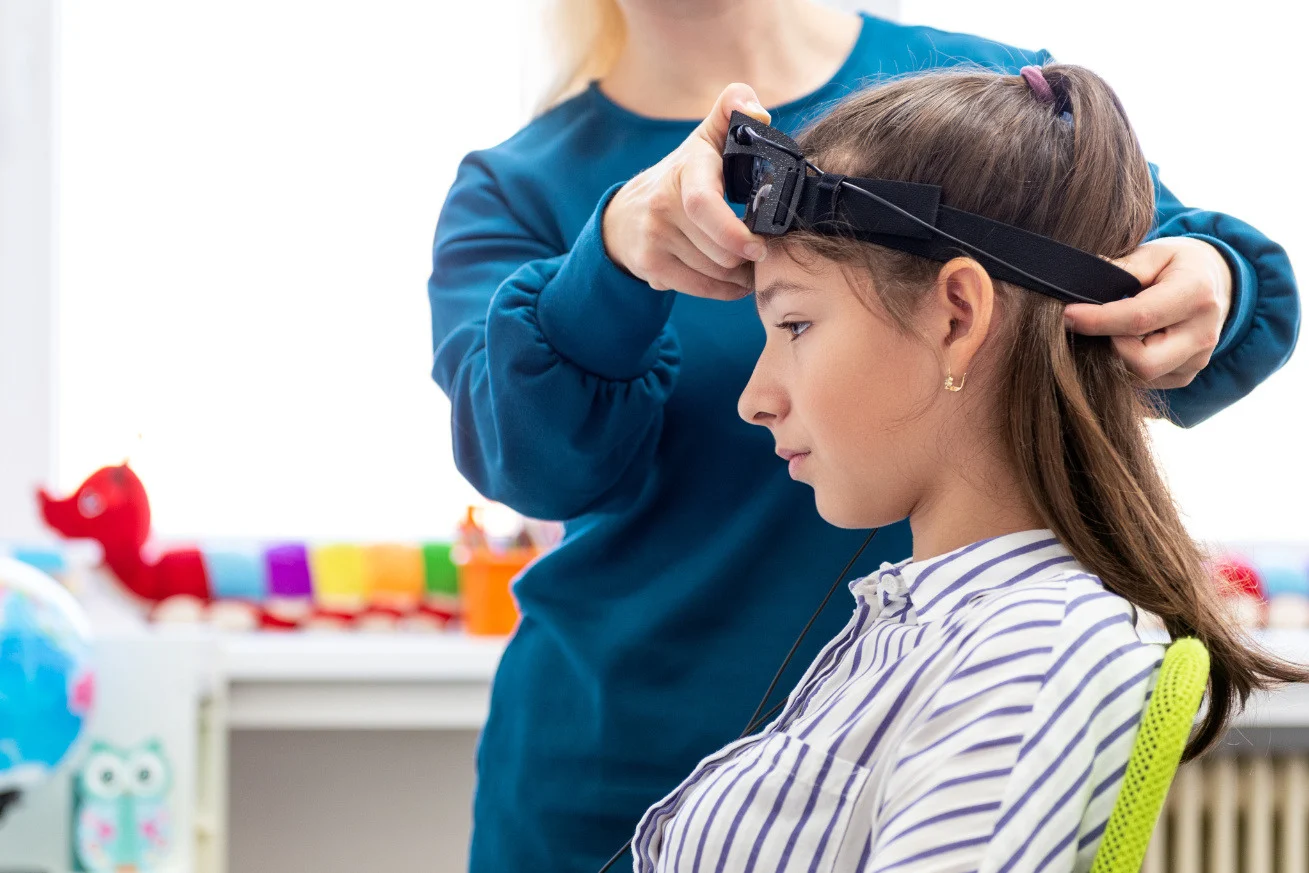
EEG allows you to record the electrical activity on a person's scalp to represent the activity of the surface layer of the brain. The gear used to measure EEG places electrodes on the head of participants.
In order to get the best results from EEG, a practitioner will use as many electrodes as possible (up to 256!), and likely place a small dot of gel between the node and the scalp in order to improve contact and sensitivity.
In recent years, new "consumer" or "pro-sumer" EEG devices have come to market that reduce the number of electrodes and improve the participant experience. However, when you have fewer electrodes in contact with the scalp, you typically reduce the reliability of the results.
Many neuromarketing providers offer EEG as a method for measuring emotions; however, emotions are complex and involve multiple deep-brain regions and distributed systems. Because EEG detects activity on the scalp, it is challenging to directly correlate EEG to emotion.
What is EEG genuinely good at
Medical-grade EEG devices have very good temporal accuracy, meaning you can quickly record electrical activity as it happens.
Newer minimal EEG headwear is less bulky and disrupting than the medical-grade "shower cap" (though it is also significantly less accurate).
EEG's strongest published result is inter-subject correlation — how synchronously a group of brains process the same content. One study found EEG synchrony predicted both Nielsen ratings and Twitter volume, and a 2025 reliability analysis (that did not include Value Measurement, BTW) rated it the most dependable of six commonly used EEG metrics. Where an audience can be seated in a lab under controlled viewing, this genuinely works.
Where does EEG fall short for measuring experiences
EEG requires an expertly trained professional to fit your subjects’ head with a cap that contains up to 256 electrodes to observe their brain. This experience is uncomfortable and distracts your audience from your content.
Processing data from EEG can take weeks and requires professionals to decipher data.
EEG has poor spatial accuracy, and can therefore not accurately identify where brain activity comes from, because the inverse problem has no unique solution — many different source distributions produce the same pattern at the scalp.
EEG provides an educated guess about active areas of the brain and it's hard to know where to go from there.
With EEG, you can understand when your audience’s brain is activated while viewing your content or partaking in some simple experience. But you cannot quantify whether they are getting value, meaning you can't predict what they will remember or how they will act later.
The metrics most vendors sell are the least reliable ones. A 2025 study in the Journal of Advertising tested EEG metric reliability across 116 participants and 13 commercials. Reliability ranged from excellent to poor — and alpha asymmetry, the approach/withdrawal measure most commonly sold in EEG neuromarketing, was the one rated poor.
The signals that do forecast behavior are ones EEG cannot see. A review of neuroforecasting excludes EEG outright, citing its "inability to resolve subcortical sources of activity" — and the deep brain structures credited with forecasting aggregate choice are exactly those.
A systematic review of 113 EEG consumer-neuroscience studies found a mean sample size of 34 and results that "do not always provide conclusive evidence."
How Value Measurement is Different
Value Measurement lets you measure the impact an experience is having while it is unfolding, as individuals experience it naturally in the real world. It does not involve trying to connect electrical activity detected outside of the skull to deep-brain regions, and it doesn't require complicated tools.
Value Measurement passively detects the peripheral footprint of the neurochemicals our brains produce in moments when our brain is fully connected to and getting value from an experience. As a result, you can measure the impact of any experience and predict future action with impeccable accuracy based on the results.
No cap, no gel, no operator, no lab — the measurement runs on a wristband while the experience happens.
Dinner party fact for brain nerds
EEG was first revealed to the world in 1875 by Richard Caton from Liverpool, England. He wanted to see the brain activity of monkeys and rabbits.
(That's, like, a really long time ago...)

Is EEG a Value Measurement?
No. EEG shows when the brain is active, not what it values. It can tell you a moment registered; it cannot tell you whether that moment was worth anything to the person having it, or what they'll do next.
Feels like magic, because it is good science
Using everyday wearable devices, we can infer the simultaneous release of oxytocin and dopamine throughout the day.

Join the Value Measurement Movement
What are you waiting for? Value Measurement lets you identify what people authentically care about and will act on, moment-by-moment, removing all bias from the equation. Download our Value Measurement Manifesto and join the movement today!